Babysense vs. Owlet: Which Is Best for Sleep Tracking and Alerts?
While Babysense builds its baby monitoring around movement, sound, and the sleep environment, Owlet is best known for physiological tracking through wearables. This guide compares how each brand's approach affects sleep tracking and alerts, and which one is the better fit for your family.






Updated September 30, 2026
AI Summary


Babysense and Owlet are two of the best-known names in baby monitoring, and it's easy to lump them together since they're often shopped side by side. But their product ranges take different approaches to the same goal.
Babysense builds its range around non-contact monitoring, cameras and under-mattress sensor pads that track movement, sound, and the nursery environment. Owlet is best known for physiological tracking through its wearable Dream Sock, though it also sells video-only monitors.
This guide breaks down how each brand approaches sleep tracking and alerts, and walks through the actual products in each range. Then it helps you figure out which one fits your family's monitoring style best.
» Learn when to contact your pediatrician about sleep concerns.
Quick Feature Overview: Babysense vs. Owlet
Despite their different approaches, both brands share some core monitoring features. Here's how they compare:
Feature | Babysense | Owlet |
|---|---|---|
Wearable required | No, fully non-contact | Yes, for Dream Sock |
HD video & night vision | Yes | Yes |
Two-way audio | Yes | Yes |
Multi-camera support | Up to 4, true split-screen | Multiple, one live feed |
FSA/HSA eligibility | Yes | Yes |
Subscription required | No | No, optional add-on |
Wi-Fi requirement | Optional | Required |
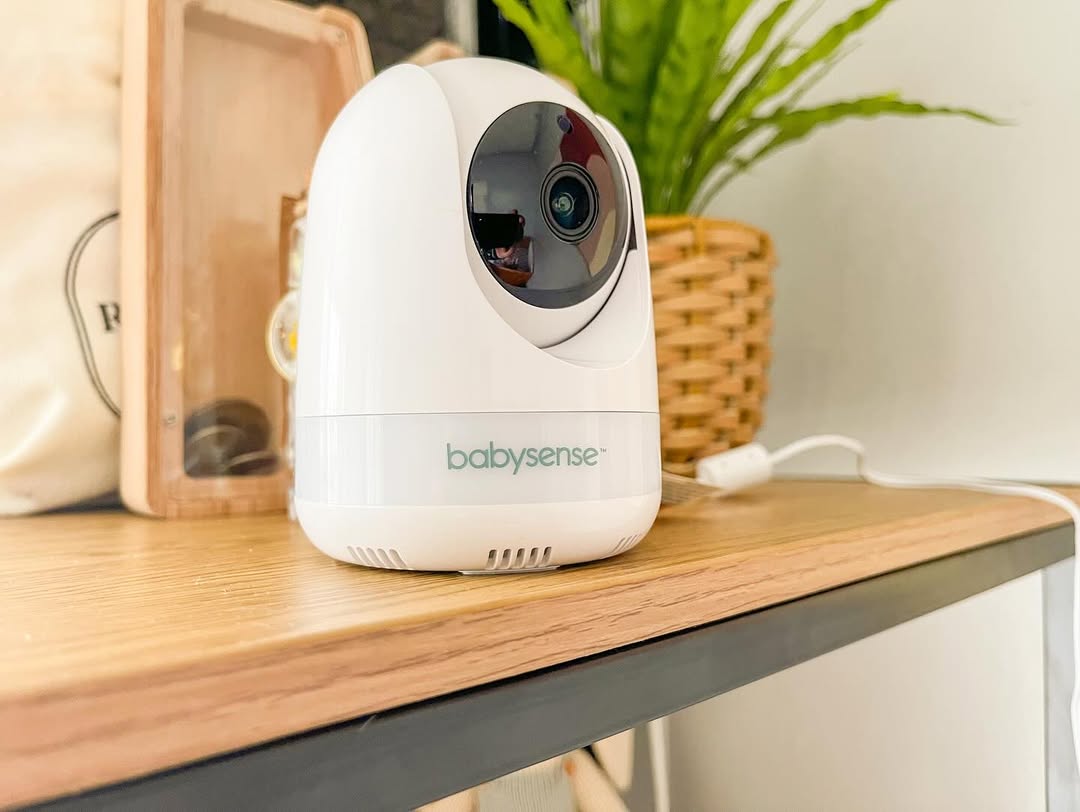
Browse Babysense Non-Wi-Fi Video Monitors
See how Babysense keeps monitoring fully private and offline, no Wi-Fi, no app, and no cloud storage.
How Babysense and Owlet Compare
Now that you know where the two brands overlap, here's a closer look at what each one actually offers.
Babysense Video Monitors and Under-Mattress Motion Sensors

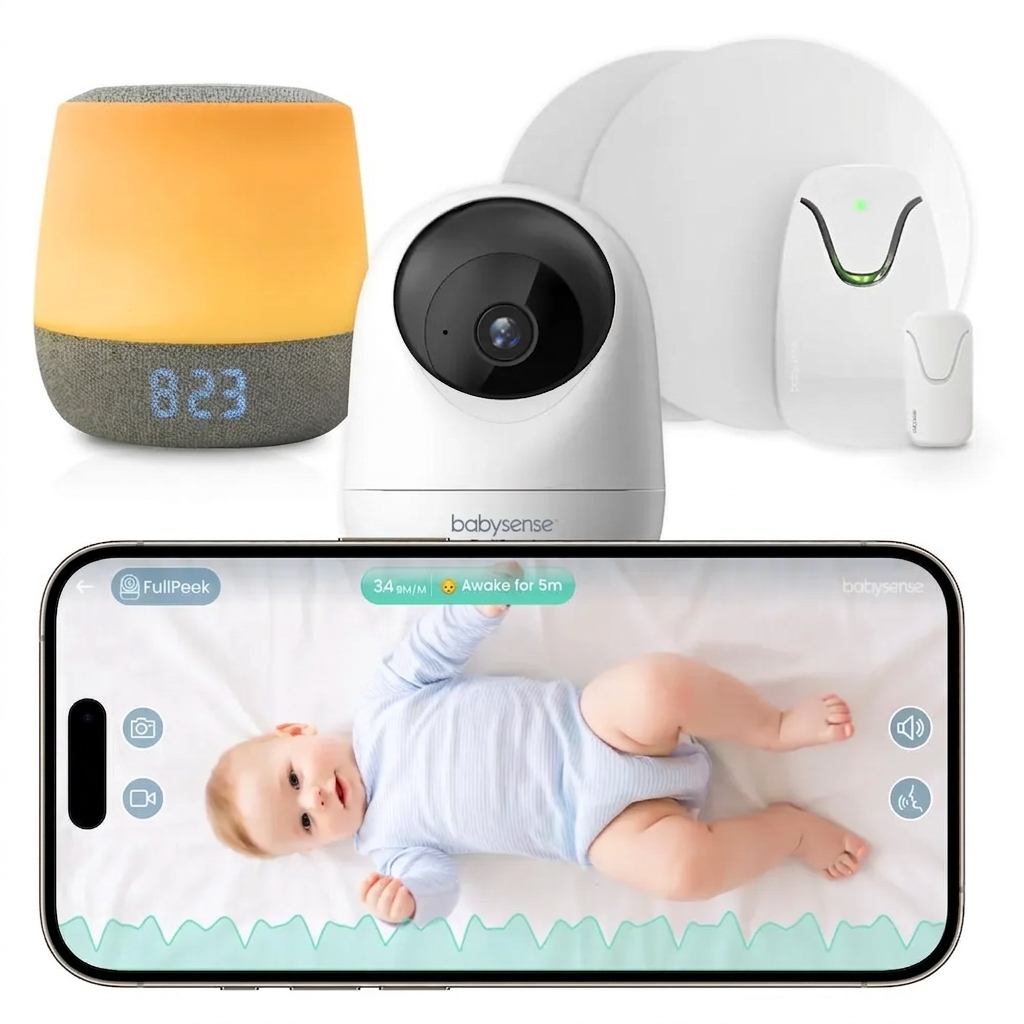
Reliable monitoring that grows with your family.
Core Focus
Movement, breathing, sound, and environment
Connectivity
Non-Wi-Fi, Wi-Fi, and hybrid options
Multi-Camera Support
Yes, up to 4 cameras
Subscription Required
No
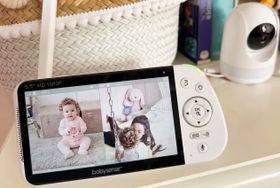
Babysense's range splits into two complementary product lines. Its video monitors, like the Babysense PRO and Touch, use HD cameras with night vision and pan-tilt-zoom. The Touch adds AI tracking too, so you can see and hear your baby directly. Alongside these sit Babysense's breathing motion monitors, like the Babysense 8 and Connect. They sit under the mattress and alert you if movement stops, with nothing touching your baby's skin.
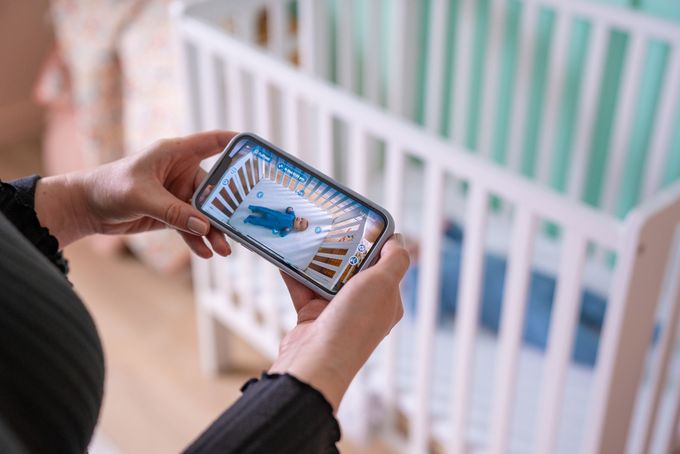
These two systems are built to work together, not replace one another. A camera shows you what's happening in the room, while sensor pads keep tracking movement even when your baby's rolled out of frame. Many parents run a breathing motion monitor for movement alerts alongside a video monitor for visual reassurance and night checks.
» Learn more about how breathing can be monitored in babies.
Pros
- Nothing attaches to your baby's skin
- Video monitors have no age limit and can be used beyond infancy
- It's multi-room ready, supporting up to 4 cameras and is split-screen
Cons
- No oxygen or pulse tracking
Owlet Video Monitors and Wearable Health Tracking
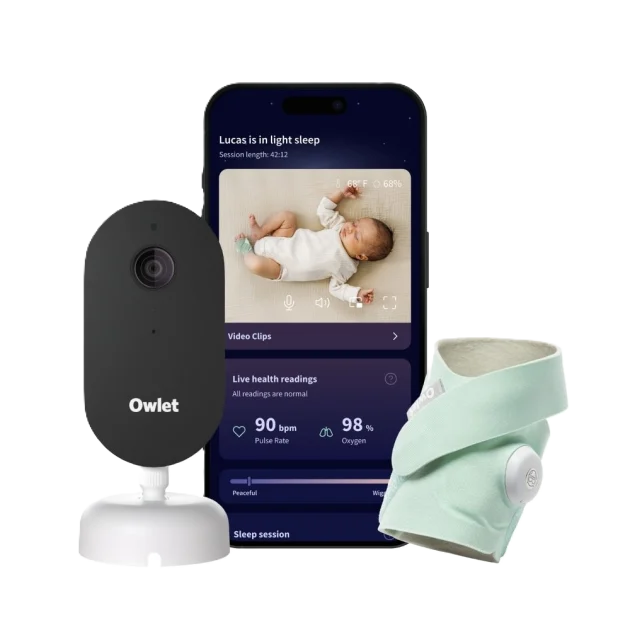
FDA-cleared insight into your baby's oxygen and pulse.
Core Focus
Physiological and video tracking
Connectivity
Wi-Fi and Bluetooth
Multi-Camera Support
Multiple, one live feed
Subscription Required
No, optional add-on
Owlet's range splits similarly into two parts. The Dream Sock is the brand's signature wearable, worn on your baby's foot to track pulse rate and oxygen saturation. In the US, it holds FDA clearance as an over-the-counter infant pulse oximetry device for healthy infants aged 1 to 18 months. It pairs with the Owlet Dream App for live readings and sleep trend data.
Owlet also sells video-only monitors, currently the Dream Sight, which stream 2K HD video straight to your phone with cry, motion, and sound detection. You can add more than one Dream Sight or Dream Sock to the same account for multiple children. The drawback is that only one live camera feed displays at a time, rather than a true side-by-side split-screen.
Pros
- Tracks pulse and oxygen in real-time
- In-depth sleep trend reports with the Owlet app
- HSA/FSA eligible
- FDA-cleared for infants 1–18 months
Cons
- Needs daily fitting, cleaning, and charging
- Tracking is limited to 1–18 months
- No simultaneous multi-camera split-screen
5 Key Differences Between Babysense and Owlet
1. Core Monitoring Style
- Babysense: Is non-contact across the board. It tracks physical movement and the nursery environment using under-mattress sensor pads and video cameras, with nothing attached to your baby.
- Owlet: Offers both approaches. The Dream Sight covers video monitoring with no wearable, while the Dream Sock tracks physiological metrics, oxygen saturation and pulse rate, on your baby's foot.
2. Daily Setup
- Babysense: No wearable, ever. Setup is a one-time process of placing sensor pads under the crib mattress and/or mounting the camera.
- Owlet: Depends on the product. The Dream Sock needs daily fitting, washing, and charging. The Dream Sight, like Babysense's video monitors, requires a one-off setup.
3. Age Window and Scalability
- Babysense: Two-part age usage. Babysense breathing motion monitors are designed for infants up to 1 year. The video monitor range has no age limit and scales up to 4 cameras as your family grows.
- Owlet: The Dream Sock's health tracking is designed for infants aged 1 to 18 months. Dream Sight cameras aren't age-limited, but if you add more cameras later on, you can only view one live feed at a time.
4. Connectivity and Privacy
- Babysense: Flexible connectivity. Offers non-Wi-Fi (closed-loop) systems for private, internet-free viewing, plus hybrid and Wi-Fi models.
- Owlet: Wi-Fi dependent. The Dream Sock connects to its base station over Bluetooth, and both the base station and Dream Sight cameras need a home Wi-Fi connection to reach the Owlet Dream App.
5. Setup Complexity
- Babysense: Plug-and-play. Turn on the monitor and camera for instant viewing, with no account creation needed on standard non-Wi-Fi models.
- Owlet: App-guided setup. Requires downloading the Owlet app, creating an account, and pairing your device over Bluetooth and/or Wi-Fi.
Choosing Between Babysense and Owlet for Sleep Tracking
Both brands are strong options, but they suit different priorities. Babysense focuses on breathing, movement, sound, and environment, giving you a scalable, wearable-free system that grows with your family. Owlet offers physiological tracking through its FDA-cleared Dream Sock, as well as video monitoring.
The best choice depends on whether your priority is broad, long-term, wearable-free monitoring, or the added depth of physiological insight during the first year and a half.
References
1. U of U Health Authors & Marketing and Communication. (2026, May 18). Are wearable baby monitors safe for sleep? A pediatrician explains. University of Utah Health. https://healthcare.utah.edu/healthfeed/2026/05/are-wearable-baby-monitors-safe-sleep-pediatrician-explains
FAQs
What's the main difference between Babysense and Owlet?
The primary difference comes down to non-contact vs. wearable monitoring. Babysense is a non-contact system that tracks movement, sound, and the nursery environment using cameras and under-mattress sensor pads, with nothing attached to your baby. Owlet offers video-only monitoring too, but is best known for its wearable Dream Sock, worn on your baby's foot to track oxygen saturation and pulse rate.
Does Babysense require a wearable device?
No. Babysense monitors use camera-based monitoring or under-mattress sensor pads, so nothing needs to be attached to your baby.
Which monitor is better for multiple children or rooms?
Babysense. Many models support up to four cameras with true split-screen viewing, so you can watch more than one child or room from a single parent unit at once. Owlet lets you add multiple cameras to one account, but only shows one live feed at a time.
Do I need Wi-Fi for Babysense or Owlet to work?
Owlet requires a home Wi-Fi connection for all of its devices. Babysense gives you a choice. Several models run on a closed, non-Wi-Fi connection for fully offline monitoring, while others offer Wi-Fi for remote access. The Touch offers both Wi-Fi and non-Wi-Fi options, depending on your needs.
Can Babysense track sleep patterns without a wearable?
Yes. Babysense Connect is a contact-free, under-mattress breathing-motion monitor that pairs with the Babysense Smart Nursery app to deliver sleep analytics, no sock or wearable required.